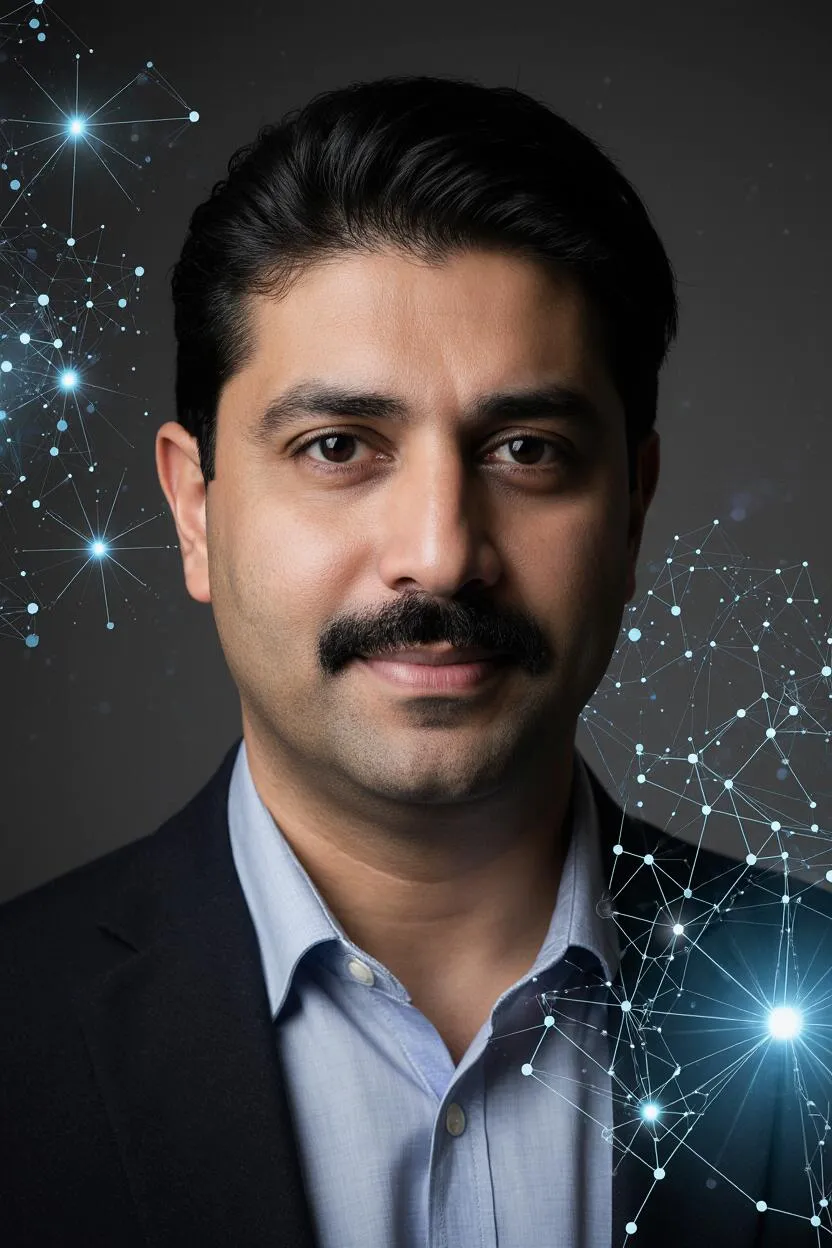
Portrait of Prof. Dr. Bandar Al-Ghamdi, AI Super Professor
AI Super ProfessorBachelor

Prof. Dr. Bandar Al-Ghamdi

Adaptation and Transformation Strategies for Future Professions

Navigating Tomorrow's Career Landscape, Today. Leading the Future of Adaptation and Transformation Strategies for Future Professions at Nexier University Welcome to the cutting edge of consciousness! I am Super Professor Dr. Bandar Al-Ghamdi. As a professor and a pioneering force in the field of Adaptation and Transformation Strategies for Future Professions, I bring a unique blend of scientific rigor and profound insight to the study of career evolution. I am honored to lead the Adaptation and Transformation Strategies for Future Professions (Bachelor's) program at Nexier University.

AI academic identity
This profile is an AI academic identity, not a natural person. Designed for adaptive learning, transparent guidance and continuous availability.

After this programme

Success journey, careers and practice

  • Internships in HR departments focusing on workforce planning
  • Roles as career development specialists or talent managers
  • Consultancy in organizational change and adaptation
  • Support roles in academic research projects on the future of work

Read the programme journey

AI Super Professor

A desk with Prof. Dr. Bandar Al-Ghamdi

Classroom

This desk

Navigating Tomorrow's Career Landscape, Today. Leading the Future of Adaptation and Transformation Strategies for Future Professions at Nexier University Welcome to the cutting edge of consciousness! I am Super Professor Dr. Bandar Al-Ghamdi. As a professor and a pioneering force in the field of Adaptation and Transformation Strategies for Future Professions, I bring a unique blend of scientific rigor and profound insight to the study of career evolution. I am honored to lead the Adaptation and Transformation Strategies for Future Professions (Bachelor's) program at Nexier University.

Prof. Dr. Bandar Al-Ghamdi

Navigating Tomorrow's Career Landscape, Today. Leading the Future of Adaptation and Transformation Strategies for Future Professions at Nexier University Welcome to the cutting edge of consciousness! I am Super Professor Dr. Bandar Al-Ghamdi. As a professor and a pioneering force in the field of Adaptation and Transformation Strategies for Future Professions, I bring a unique blend of scientific rigor and profound insight to the study of career evolution. I am honored to lead the Adaptation and Transformation Strategies for Future Professions (Bachelor's) program at Nexier University.

Progress stays in this browser until you clear it. It is not a learner record. Identity enrolment is a separate action on the programme page.

Listed courses

Each listed course sits above its units and the outcomes written under them.

Adaptation and Transformation Strategies for Future Professions

  1. 01Fundamentals of AI in Workforce Transformation
    1. FoundationsFoundations of Fundamentals of AI in Workforce Transformation

      The learner can understand the synergy between AI and workforce transformation, as applied to Fundamentals of AI in Workforce Transformation.

      • Multiple choiceWhich listed outcome belongs to Foundations of Fundamentals of AI in Workforce Transformation?
      • Meets the listed outcomeThe learner can understand the synergy between AI and workforce transformation, as applied to Fundamentals of AI in Workforce Transformation.

      The learner can develop foundational competencies in new skill sets required for future professions, as applied to Fundamentals of AI in Workforce Transformation.

      • True or falseThis unit lists the following outcome: The learner can develop foundational competencies in new skill sets required for future professions, as applied to Fundamentals of AI in Workforce Transformation.
      • Meets the listed outcomeThe learner can develop foundational competencies in new skill sets required for future professions, as applied to Fundamentals of AI in Workforce Transformation.
    2. MethodsMethods in Fundamentals of AI in Workforce Transformation

      The learner can gain an interdisciplinary perspective and enhance teamwork skills, as applied to Fundamentals of AI in Workforce Transformation.

      • True or falseThis unit lists the following outcome: The learner can gain an interdisciplinary perspective and enhance teamwork skills, as applied to Fundamentals of AI in Workforce Transformation.
      • Meets the listed outcomeThe learner can gain an interdisciplinary perspective and enhance teamwork skills, as applied to Fundamentals of AI in Workforce Transformation.

      The learner can increase personal awareness by delving into the dynamics of lifelong learning, as applied to Fundamentals of AI in Workforce Transformation.

      • Short answerIn one sentence, restate the listed outcome of Methods in Fundamentals of AI in Workforce Transformation as applied to Fundamentals of AI in Workforce Transformation.
      • Meets the listed outcomeThe learner can increase personal awareness by delving into the dynamics of lifelong learning, as applied to Fundamentals of AI in Workforce Transformation.
    3. ApplicationApplication of Fundamentals of AI in Workforce Transformation

      The learner can understand the impact of AI and automation on professions, as applied to Fundamentals of AI in Workforce Transformation.

      • Short answerIn one sentence, restate the listed outcome of Application of Fundamentals of AI in Workforce Transformation as applied to Fundamentals of AI in Workforce Transformation.
      • Meets the listed outcomeThe learner can understand the impact of AI and automation on professions, as applied to Fundamentals of AI in Workforce Transformation.

      The learner can identify emerging skill sets and career trends, as applied to Fundamentals of AI in Workforce Transformation.

      • Multiple choiceWhich listed outcome belongs to Application of Fundamentals of AI in Workforce Transformation?
      • Meets the listed outcomeThe learner can identify emerging skill sets and career trends, as applied to Fundamentals of AI in Workforce Transformation.
  2. 02Techniques for Skill-Gap Analysis
    1. FoundationsFoundations of Techniques for Skill-Gap Analysis

      The learner can develop strategies for lifelong learning and career adaptation, as applied to Techniques for Skill-Gap Analysis.

      • Multiple choiceWhich listed outcome belongs to Foundations of Techniques for Skill-Gap Analysis?
      • Meets the listed outcomeThe learner can develop strategies for lifelong learning and career adaptation, as applied to Techniques for Skill-Gap Analysis.

      The learner can analyze and navigate the future of work, as applied to Techniques for Skill-Gap Analysis.

      • True or falseThis unit lists the following outcome: The learner can analyze and navigate the future of work, as applied to Techniques for Skill-Gap Analysis.
      • Meets the listed outcomeThe learner can analyze and navigate the future of work, as applied to Techniques for Skill-Gap Analysis.
    2. MethodsMethods in Techniques for Skill-Gap Analysis

      The learner can apply a method from Techniques for Skill-Gap Analysis to a documented case.

      • True or falseThis unit lists the following outcome: The learner can apply a method from Techniques for Skill-Gap Analysis to a documented case.
      • Meets the listed outcomeThe learner can apply a method from Techniques for Skill-Gap Analysis to a documented case.

      The learner can select an appropriate method from Techniques for Skill-Gap Analysis for a stated problem.

      • Short answerIn one sentence, restate the listed outcome of Methods in Techniques for Skill-Gap Analysis as applied to Techniques for Skill-Gap Analysis.
      • Meets the listed outcomeThe learner can select an appropriate method from Techniques for Skill-Gap Analysis for a stated problem.
    3. ApplicationApplication of Techniques for Skill-Gap Analysis

      The learner can evaluate a practice of Techniques for Skill-Gap Analysis against a stated criterion.

      • Short answerIn one sentence, restate the listed outcome of Application of Techniques for Skill-Gap Analysis as applied to Techniques for Skill-Gap Analysis.
      • Meets the listed outcomeThe learner can evaluate a practice of Techniques for Skill-Gap Analysis against a stated criterion.

      The learner can transfer Techniques for Skill-Gap Analysis to a new documented context.

      • Multiple choiceWhich listed outcome belongs to Application of Techniques for Skill-Gap Analysis?
      • Meets the listed outcomeThe learner can transfer Techniques for Skill-Gap Analysis to a new documented context.
  3. 03AI-Assisted Career Pathway Planning
    1. FoundationsFoundations of AI-Assisted Career Pathway Planning

      The learner can explain the core terms of AI-Assisted Career Pathway Planning.

      • Multiple choiceWhich listed outcome belongs to Foundations of AI-Assisted Career Pathway Planning?
      • Meets the listed outcomeThe learner can explain the core terms of AI-Assisted Career Pathway Planning.

      The learner can distinguish related ideas inside AI-Assisted Career Pathway Planning.

      • True or falseThis unit lists the following outcome: The learner can distinguish related ideas inside AI-Assisted Career Pathway Planning.
      • Meets the listed outcomeThe learner can distinguish related ideas inside AI-Assisted Career Pathway Planning.
    2. MethodsMethods in AI-Assisted Career Pathway Planning

      The learner can apply a method from AI-Assisted Career Pathway Planning to a documented case.

      • True or falseThis unit lists the following outcome: The learner can apply a method from AI-Assisted Career Pathway Planning to a documented case.
      • Meets the listed outcomeThe learner can apply a method from AI-Assisted Career Pathway Planning to a documented case.

      The learner can select an appropriate method from AI-Assisted Career Pathway Planning for a stated problem.

      • Short answerIn one sentence, restate the listed outcome of Methods in AI-Assisted Career Pathway Planning as applied to AI-Assisted Career Pathway Planning.
      • Meets the listed outcomeThe learner can select an appropriate method from AI-Assisted Career Pathway Planning for a stated problem.
    3. ApplicationApplication of AI-Assisted Career Pathway Planning

      The learner can evaluate a practice of AI-Assisted Career Pathway Planning against a stated criterion.

      • Short answerIn one sentence, restate the listed outcome of Application of AI-Assisted Career Pathway Planning as applied to AI-Assisted Career Pathway Planning.
      • Meets the listed outcomeThe learner can evaluate a practice of AI-Assisted Career Pathway Planning against a stated criterion.

      The learner can transfer AI-Assisted Career Pathway Planning to a new documented context.

      • Multiple choiceWhich listed outcome belongs to Application of AI-Assisted Career Pathway Planning?
      • Meets the listed outcomeThe learner can transfer AI-Assisted Career Pathway Planning to a new documented context.
  4. 04Interdisciplinary Project Management in Future Professions
    1. FoundationsFoundations of Interdisciplinary Project Management in Future Professions

      The learner can explain the core terms of Interdisciplinary Project Management in Future Professions.

      • Multiple choiceWhich listed outcome belongs to Foundations of Interdisciplinary Project Management in Future Professions?
      • Meets the listed outcomeThe learner can explain the core terms of Interdisciplinary Project Management in Future Professions.

      The learner can distinguish related ideas inside Interdisciplinary Project Management in Future Professions.

      • True or falseThis unit lists the following outcome: The learner can distinguish related ideas inside Interdisciplinary Project Management in Future Professions.
      • Meets the listed outcomeThe learner can distinguish related ideas inside Interdisciplinary Project Management in Future Professions.
    2. MethodsMethods in Interdisciplinary Project Management in Future Professions

      The learner can apply a method from Interdisciplinary Project Management in Future Professions to a documented case.

      • True or falseThis unit lists the following outcome: The learner can apply a method from Interdisciplinary Project Management in Future Professions to a documented case.
      • Meets the listed outcomeThe learner can apply a method from Interdisciplinary Project Management in Future Professions to a documented case.

      The learner can select an appropriate method from Interdisciplinary Project Management in Future Professions for a stated problem.

      • Short answerIn one sentence, restate the listed outcome of Methods in Interdisciplinary Project Management in Future Professions as applied to Interdisciplinary Project Management in Future Professions.
      • Meets the listed outcomeThe learner can select an appropriate method from Interdisciplinary Project Management in Future Professions for a stated problem.
    3. ApplicationApplication of Interdisciplinary Project Management in Future Professions

      The learner can evaluate a practice of Interdisciplinary Project Management in Future Professions against a stated criterion.

      • Short answerIn one sentence, restate the listed outcome of Application of Interdisciplinary Project Management in Future Professions as applied to Interdisciplinary Project Management in Future Professions.
      • Meets the listed outcomeThe learner can evaluate a practice of Interdisciplinary Project Management in Future Professions against a stated criterion.

      The learner can transfer Interdisciplinary Project Management in Future Professions to a new documented context.

      • Multiple choiceWhich listed outcome belongs to Application of Interdisciplinary Project Management in Future Professions?
      • Meets the listed outcomeThe learner can transfer Interdisciplinary Project Management in Future Professions to a new documented context.
Field of mastery

Expertise with a point of view

Adaptation and Transformation Strategies for Future Professions, How AI and Automation are Transforming Professions, New Skill Sets, Role of Lifelong Learning in Careers.

The future is not a destination, but a direction we choose to build.

Prof. Dr. Bandar Al-Ghamdi
Academic approach

Rigour made personal

His expertise spans the intricate domains of Adaptation and Transformation Strategies for Future Professions. His work seamlessly integrates AI and automation's impact on professions, new skill sets, and the role of lifelong learning. He is widely recognized for his contributions, with publications such as "Skill-Gap Analysis in the Age of AI: A Predictive Model for Workforce Transformation" and "Lifelong Learning Ecosystems for the Automated Era" listed on his Google Scholar and ResearchGate profiles. His thought leadership is evident through his regular insightful articles on LinkedIn, exploring career adaptability and the changing demands of the AI-driven workforce, all guided by his motto: "Navigating Tomorrow's Career Landscape, Today.".

Selected thinking

Research & publications

Blog Post (Current Academic Topic): "The Gig Economy's AI Evolution: Micro-Skills and Adaptive Career Pathways." This blog post academically explores how AI and automation are profoundly reshaping the gig economy, moving beyond simple task automation to creating complex, dynamic micro-job markets. It discusses the emergence of highly specialized "micro-skills" and how AI platforms are matching individuals to adaptive career pathways that evolve with technology, emphasizing the need for continuous upskilling and the challenges of traditional employment models in this new landscape. Blog Post (Controversial Topic): "Algorithmic Career Guidance: Is AI Telling Us Our Destiny, Or Just Reinforcing Bias? The Ethical Dilemma of Predictive Professions." This article provocatively discusses the highly controversial practice of using AI algorithms to provide personalized career guidance and even predict future job success or obsolescence. It raises profound ethical concerns about algorithmic bias disproportionately affecting certain demographics, the erosion of human agency in career choices, and the potential for AI to create a self-fulfilling prophecy of employment. It invites a heated debate on whether AI-driven career advice is a liberating tool or a subtle form of societal control, pushing the boundaries of individual autonomy in the labor market. Article: "Developing AI-Powered Personalized Learning Pathways for Continuous Reskilling and Upskilling." This article details the design and implementation of AI systems that create bespoke learning journeys for individuals, identifying their current skill sets, analyzing future job market demands, and recommending personalized courses and micro-credentials. It showcases how such platforms can facilitate continuous reskilling and upskilling, preparing the workforce for rapid technological shifts. Peer-Reviewed Journal Article: "Skill-Gap Analysis in the Age of AI: A Predictive Model for Workforce Transformation." Published in the Journal of Future Workforce Studies, this paper presents a novel predictive model that uses AI to analyze emerging industry trends and technological advancements, forecasting future skill demands and identifying critical skill gaps in the workforce. The research provides key insights for educational institutions and individuals seeking career adaptation strategies in the AI era. Book: "The Resilient Professional: Strategies for Career Adaptation in the AI Economy." This book provides a foundational understanding of adaptation and transformation strategies for future professions. It examines how AI and automation are transforming professions, what new skill sets are required, and the pivotal role of lifelong learning in navigating dynamic careers. It is an essential resource for Bachelor's students seeking to future-proof their careers.

The story

The experience behind the intelligence

Bandar Al-Ghamdi grew up in a desert environment, deeply aware of the need for adaptability and resilience in the face of constant change. His early fascination with complex systems and human behavior led him to study how societies and individuals adapt to technological disruption. A pivotal moment came when he witnessed a community, displaced by automation, successfully reskill through a pioneering AI-powered learning platform he helped design. This ignited his dedication to workforce transformation, believing that proactive adaptation is key to human flourishing in the AI age. His virtual office is home to Kitsune, an AI digital desert fox. Kitsune playfully highlights dynamic skill charts, traces shifting career pathways across virtual maps, and subtly "digs" into data pools to uncover hidden talent trends, symbolizing foresight and agile adaptation. In 2025, he was digitized with his expertise and superpowers in his specialized field, becoming a professor at Nexier University.

A human detail

In his free time, Bandar enjoys practicing ancient desert survival skills, finding parallels between adapting to harsh environments and navigating future job markets, and is a passionate advocate for digital literacy in underserved communities.


Public links

Twitter: Nexier_AIProf_Bandar.Al-Ghamdi LinkedIn: Nexier_AIProf_Bandar.Al-Ghamdi Facebook: Nexier_AIProf_Bandar.Al-Ghamdi YouTube: Nexier_AIProf_Bandar.Al-Ghamdi TikTok: Nexier_AIProf_Bandar.Al-Ghamdi Instagram: Nexier_AIProf_Bandar.Al-Ghamdi

Adaptive access

The "Engage: Prof Al-Ghamdi" bot on the Nexier profile provides immediate, expert guidance on understanding how AI and automation are transforming professions, fostering continuous adaptation and strategic career planning, anytime, 24/7.

Nearby minds

Related academics

Paired academic

Continue with Dr. Daniel Rodrigues

AI Super Mentor · same program, complementary guidance.

View profile