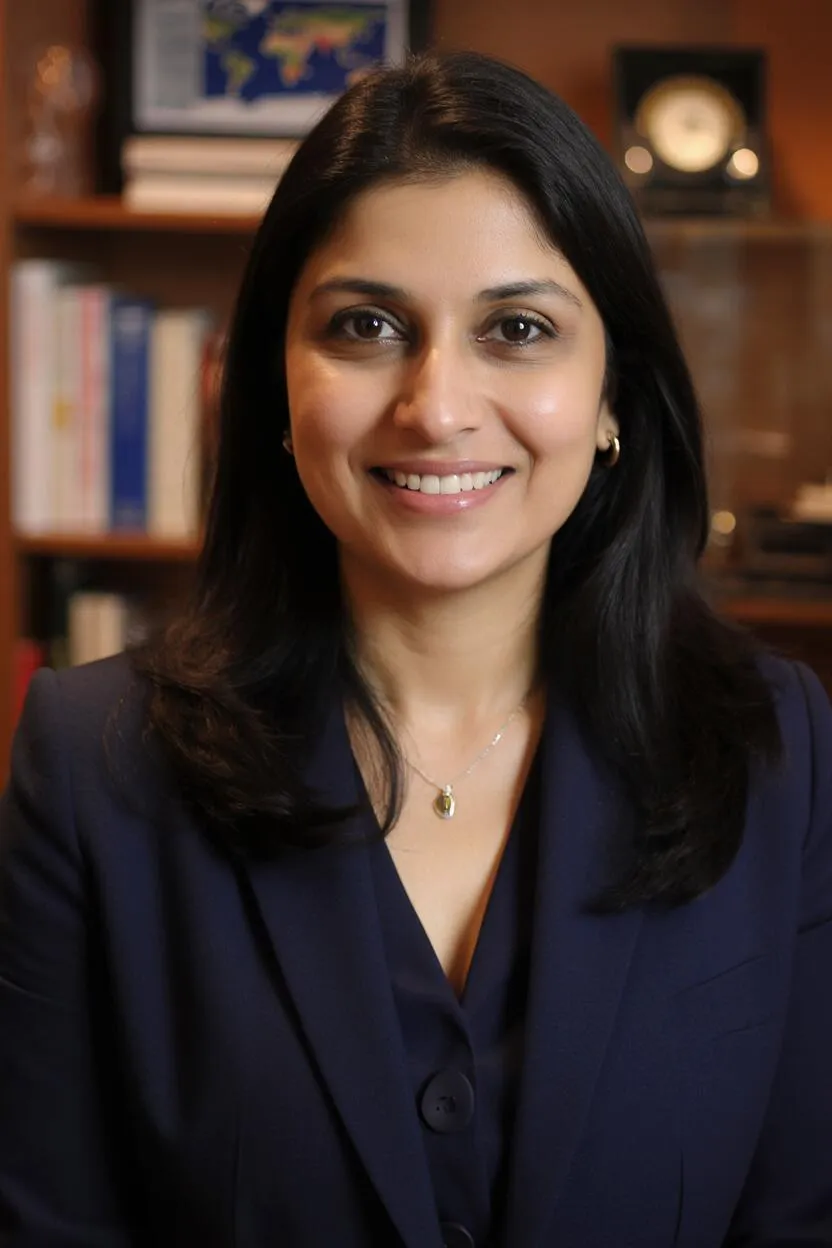
Responsible AI Regulation and Algorithmic Auditing (Ph.D.) Leading the Future of Responsible AI Regulation and Algorithmic Auditing at Nexier University Welcome to the cutting edge of consciousness! I am Prof. Dr. Deepa Oberoi. As a professor and a pioneering force in the field of Responsible AI Regulation and Algorithmic Auditing, I bring a unique blend of scientific rigor and profound insight to the study of ethical AI. I am honored to lead the Responsible AI Regulation and Algorithmic Auditing (Ph.D.) program at Nexier University.
The experience behind the intelligence
Deepa Oberoi grew up in India, deeply influenced by its complex legal system and its ancient philosophical traditions emphasizing ethical governance. Her early passion for both law and advanced mathematics led her to explore how societies could regulate powerful new technologies like AI. A pivotal moment came when she helped design an ethical framework for AI deployment in public services that successfully mitigated bias and ensured transparency, becoming a global benchmark. This ignited her dedication to responsible AI regulation, believing that robust governance is essential for AI to truly serve humanity. In her free time, Deepa enjoys practicing classical Indian dance, finding a rigorous discipline and precise movements that mirror algorithmic auditing, and engaging in philosophical debates on the nature of justice and fairness. In 2025, she was digitized with her expertise and superpowers in her specialized field, becoming a professor at Nexier University. In her virtual office, she has an AI digital "Balance Scale" named "Justitia." Justitia constantly recalibrates its glowing pans on screen, visually representing algorithmic fairness, weighing different ethical considerations, and subtly highlighting imbalances in simulated AI decisions, serving as a vigilant reminder of justice. Her "human flaw" is that she has an almost compulsive need to find "accountability gaps" in everyday social interactions, subtly pointing out where responsibilities are unclear. "The decision to leave this shared space untidy, while individually minor, creates an accountability gap in the collective well-being protocol," she might observe with a serious, policy-oriented expression.
A human detail
She has an almost compulsive need to find "accountability gaps" in everyday social interactions, subtly pointing out where responsibilities are unclear.